Author Archives: gilmedia

Washing Machine Not Spinning in Halifax? Causes, Fixes, and Costs

halifax washing machine not spinning

A washing machine that won’t spin leaves your clothes soaking wet and your laundry day completely derailed. In Halifax, where coastal humidity means damp clothes can sit for a while before they dry on their own, a non-spinning washer is more than a minor inconvenience. Before you call someone or start researching new machines, here’s what to check. For professional help, washing machine repair in Halifax is available same-day for most issues.

Unbalanced Load and Load Sensing

Modern washers have sensors that detect an unbalanced drum during the spin cycle and will slow down or stop spinning to prevent damage. If you notice your machine starts a spin, pauses, tries again a few times, then stops or displays an error code, an unbalanced load is the first thing to check.

Redistribute the load manually. Heavy items like jeans or towels tend to bunch on one side of the drum. Remove everything, redistribute evenly, and restart the spin cycle. This isn’t a component failure at all but it’s the cause of a surprising number of “washer won’t spin” calls.

HE front-load washers are particularly sensitive to this. They’re designed for smaller loads than older top-loaders, and overfilling them guarantees an out-of-balance spin failure. If your front-loader consistently struggles with spin cycles, you may simply be overloading it. The general rule for HE front-loaders is fill to about 80% capacity, which still looks quite full.

One note on Halifax laundry habits: many people in the city run large loads with heavy maritime gear, work uniforms, and thick winter clothes. These items are exactly what causes balance issues. Breaking one large load into two medium loads solves the spin problem without any repair needed.

Lid Switch (Top Loaders) and Door Latch (Front Loaders)

Top-loading washing machines won’t spin unless the lid switch signals that the lid is closed. When this switch fails, the machine typically fills and agitates normally but stops dead before the spin cycle begins. It’s a safety mechanism and one of the most common top-loader failures.

You can test the lid switch with a multimeter: it should show continuity when the lid is closed. Replacement switches typically run $15 to $30 and are accessible from inside the machine once the top panel is removed. On machines that are otherwise functioning normally, a lid switch is usually a same-morning DIY fix.

Front-loading machines use a door latch assembly instead. The latch must close and lock before the machine allows any water in or the drum to spin. If the latch is worn, the door doesn’t close solidly, or the latch switch has failed, the machine will either refuse to start or interrupt mid-cycle when it senses an unlocked door.

Front-loader door latches are more complex than lid switches, involving both the mechanical latch and an electronic lock solenoid. Parts run $30 to $60 and the replacement is moderately complex, requiring removal of the door boot seal on most models to access the latch from inside. If the door itself isn’t closing flush, the hinge may also need adjustment.

Drain Pump Failure

Most washing machines require a complete drain before they’ll enter the high-speed spin cycle. If the drain pump is failing or blocked, the machine can’t drain water out, and the spin cycle won’t run because the machine detects water still in the drum.

Symptoms: the washer stops mid-cycle with water in the drum, often displaying a drain error code. Some machines will attempt to drain for a set time, give up, and lock. Others will just pause indefinitely with the drum full of water.

The drain pump can fail mechanically (impeller is broken or seized) or it can be blocked by a foreign object. Halifax front-load users should know that most machines have a small filter at the bottom front of the machine, accessible through a small panel. This filter catches coins, hair ties, and small items before they reach the pump. If yours has never been cleaned, start there before assuming the pump is bad.

An impeller that’s seized from debris usually makes a loud humming noise when the machine tries to drain. A completely failed pump motor makes no sound at all. Replacement pumps run $40 to $80 for most brands. Labour to swap one is typically 30 to 45 minutes.

Motor Coupling and Drive Belt

On top-loading machines, particularly older Whirlpool and Maytag designs, a plastic motor coupling connects the motor to the transmission. This coupling is designed to break before the motor or transmission takes damage from a seized pump or overloaded drum. When it breaks, the motor runs and makes noise, but the drum doesn’t move.

Motor coupling failures are more common on older machines and machines that are habitually overloaded. The coupling itself costs $10 to $20. Replacement requires tipping the machine and removing the pump and motor, which is straightforward but physical work. On a machine that’s otherwise in good condition, a coupling replacement is one of the most cost-effective repairs you can make.

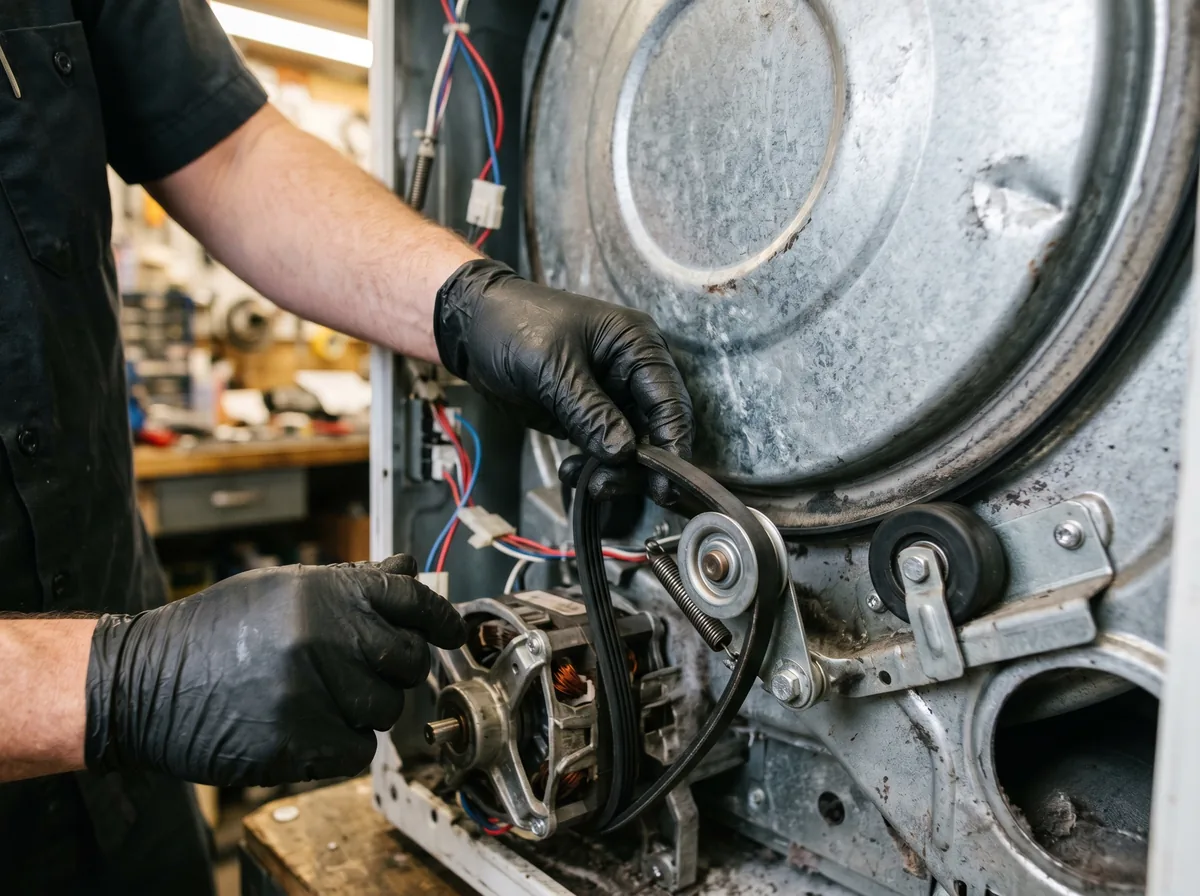
Front-loading machines and some newer top-loaders use a direct-drive motor and don’t have a coupling or belt. However, many machines from Samsung, LG, and some GE models use a belt between the motor and drum. A snapped belt produces a similar symptom: motor hums or runs, drum doesn’t move. Belts are inexpensive ($10 to $30) but getting to them requires significant disassembly on front-loaders.

Control Board and Motor Control Issues

When the machine fills normally and appears to reach the spin portion of the cycle but then does nothing, with no noise and no movement, the motor control board or main control board may have failed. These boards control when and how fast the motor runs, including the spin speed.

Control board failures are rarely the first thing to check. They’re expensive to replace and easy to misdiagnose. Before assuming the board is bad, confirm that the motor itself is functional (it typically makes some noise even when a board issue is preventing proper operation), that wiring connections are secure, and that no error codes point to a specific component.

Motor control boards are brand and model specific. Replacement costs vary widely, from $80 for a common Samsung motor board to $250 or more for some Miele or Bosch units. A technician with diagnostic experience can usually isolate a board failure in under 30 minutes using a voltage test at the board output terminals.

Front Loader Drum Bearing Wear

This is the most expensive washing machine repair short of replacing the machine. The drum bearing supports the weight of the drum and allows it to spin smoothly. When it wears out, the drum wobbles, metal-on-metal contact develops, and the spin cycle becomes loud enough to rattle the walls.

Halifax front-load owners in older homes with vibration-prone laundry closets may notice this problem earlier than average, because the constant vibration of an improperly mounted machine accelerates bearing wear. A machine that shakes violently during spin cycles is both annoying and a bearing-killer.

By the time a bearing has failed, the noise is unmistakable: a loud grinding or roaring during spin that gets worse at high speeds. The repair itself involves replacing the bearing and shaft seal inside the drum assembly, which requires nearly complete disassembly. Labour time runs 2 to 3 hours on most front-loaders.

On machines under 6 years old in otherwise good condition, bearing repair makes sense. On a 10-year-old machine that’s already seen other repairs, the cost of a bearing job often approaches the value of a similar used appliance.

FAQ: Washing Machine Not Spinning in Halifax

Why does my washer fill and wash but stop before spinning?

This is almost always a lid switch failure (top loaders), a door latch issue (front loaders), or a drain problem that prevents the machine from emptying before the spin cycle. Check the lid or door closure first. If that’s fine, check whether there’s still water in the drum before it refuses to spin.

My washing machine is making a loud grinding noise during spin. What is it?

Loud grinding or roaring during spin on a front-loader is almost always a drum bearing. On a top-loader, it could be a worn clutch or worn drum bearings. Both are serious mechanical failures that won’t resolve on their own and will get worse until something breaks completely. Get it diagnosed soon.

How much does washing machine repair cost in Halifax?

Lid switch and door latch replacements run $80 to $160 installed. Drain pump replacement is $120 to $200. Motor coupling is $80 to $140. Drum bearing replacement is $250 to $450 depending on the brand and labour time required. Diagnostic call-outs in Halifax are typically $80 to $100, credited toward the repair.

Can I manually spin clothes in a washer that won’t spin?

There’s no safe manual spin option. What you can do is remove very wet clothes and wring them by hand, then run them through the spin cycle of a working machine if you have access to one, or take them to a laundromat for a spin cycle only. It’s not a solution but it handles the immediate problem while you arrange a repair.

Is a 9-year-old washer worth repairing if the motor coupling fails?

Yes. A motor coupling on a 9-year-old machine is a $80 to $140 repair on an appliance that likely has years of life left if otherwise maintained. The coupling is a wear part, not a sign the machine is failing. Contrast this with a drum bearing job on the same machine, where the math is closer and worth discussing with a technician before committing.

Need Washing Machine Repair in Halifax?

Max Appliance Repair covers Halifax, Dartmouth, Bedford, Timberlea, and across HRM. Same-day appliance repair is available most days. Whether your front-loader is stuck mid-cycle or your top-loader never makes it to spin, a diagnostic visit is the fastest way to get back to a working laundry routine. Book online or call today.

Hard Water and Halifax Appliances: What Well Water and HRM Tap Water Are Doing to Your Dishwasher and Washer

Open dishwasher in a Halifax kitchen showing white calcium scale film on the inside of the door

Most Halifax homeowners assume that because HRM tap water is “soft” they have nothing to worry about. That is half right. Pockwock supply water is genuinely soft. But thousands of Halifax-area homes get their water from private wells in Hammonds Plains, Tantallon, Fall River, Lakeside, Beaver Bank, and the rural fringe of HRM, and those wells run from moderately hard to very hard depending on the bedrock. Even on the municipal supply, the mineral profile changes by neighbourhood. After 16 years of washer repair and dishwasher repair calls across HRM and the South Shore, here is what Halifax water is actually doing to your appliances and how to slow it down.

Pockwock vs private well: the real Halifax water story

HRM gets most of its drinking water from the Pockwock Lake supply, which Halifax Water reports at roughly 10 to 20 mg/L of calcium carbonate hardness. That is genuinely soft and your dishwasher will be happy. Lake Major supplies Dartmouth and is similarly soft. But once you go off-grid onto a private well, the numbers change fast. Slate and granite bedrock wells in the Hammonds Plains corridor often test 150 to 300 mg/L. Limestone-influenced wells in some pockets can hit 400 mg/L or higher. That is the territory where appliances start failing in distinctly hard-water ways. The Nova Scotia Environment well water guidance recommends water testing every two years for private wells, and the hardness number on that test is the one your appliance technician cares about.

Dishwasher heating element coated in heavy white calcium scale from hard well water
Whole house water softener and brine tank installed in a Hammonds Plains basement utility room
Infographic showing water hardness scale and softener recommendations for Halifax homes

What hard water actually does inside an appliance

Calcium and magnesium dissolved in your water do not stay dissolved when the water is heated. They precipitate out as scale, a chalky white deposit that bonds to any heated surface. Inside your appliances, that means heating elements, spray arms, water inlet valves, pump impellers, and the inside walls of the tub. Scale insulates heating elements from the water around them, so the element runs hotter to deliver the same wash temperature, then burns out years early. Scale clogs spray arm holes and inlet valves, restricting water flow and triggering error codes. Scale roughens pump impellers and chews up seals.

Dishwasher damage signs you can spot yourself

  • White film on the inside of the door and the upper rack. Pull the upper rack and look at the back wall above the upper spray arm. White cloudy buildup that does not wipe off easily is calcium scale.
  • Glasses come out spotty even with good detergent and rinse aid. Spotty glassware is the earliest visible symptom and the easiest to ignore.
  • The dishwasher takes longer to finish a cycle than it used to. Modern dishwashers extend the cycle when the heating element cannot bring the water to temperature on schedule. That is the unit compensating for scale insulation on the element.
  • Intermittent E1, E15, or H20 type fill codes. Scale on the inlet valve restricts water flow below the threshold the control board expects.
  • Audible whine from the wash pump that was not there a year ago. Scale on the impeller throws the rotation off balance.

Washing machine damage signs

  • Whites going grey and towels feeling stiff. Scale binds with detergent, leaving residue in fabric. You add more detergent to compensate, the residue gets worse.
  • Visible scale on the rubber door gasket of a front-loader. White crust around the lip of the gasket means scale is also building inside the tub and on the heating element.
  • Heating element burning out before 8 years. A front-load washer heating element should last 12 plus years on soft water. We routinely replace them at 5 to 7 years on private wells in Hammonds Plains and Tantallon.
  • Solenoid water inlet valves clogging and triggering “long fill” or LE error codes. Same mechanism as dishwasher inlet valves.

What to do about it

Step 1: actually test your water

If you are on a private well, send a sample to a Nova Scotia accredited lab and get the hardness number plus iron, manganese, and pH. If you are on HRM municipal supply, you can pull the latest hardness reading from Halifax Water without testing. Knowing the number tells you whether you need a softener at all and how much capacity you need.

Step 2: install a whole-house softener if your hardness is over 120 mg/L

Below 120 mg/L (about 7 grains per gallon), you can usually manage with appliance maintenance alone. Above that number, a properly sized ion exchange softener pays for itself in extended appliance life inside 5 years. A typical Halifax-area whole-house softener installed runs $1,800 to $3,500. The math: at 250 mg/L hardness, untreated water shortens dishwasher and washer life by roughly 30 percent and shortens heating element life by 50 percent. One avoided heating element replacement plus one avoided early appliance replacement covers the softener.

Step 3: descale the appliances you already have

For dishwashers, run a cycle with a citric acid based dishwasher cleaner once a month. Avoid the hardware store products that use hydrochloric acid, which attack rubber seals. For front-load washers, run a hot tub clean cycle with a washing machine descaler monthly. Both are cheap, both work, neither will reverse advanced scale damage but both will stop the progression.

Step 4: use the rinse aid dispenser on your dishwasher, every cycle

Rinse aid is not a luxury and it is not just for spot prevention. The surfactant in rinse aid breaks the surface tension of the rinse water so it sheets off dishes instead of beading and leaving mineral residue. Even on Pockwock soft water, rinse aid helps. On hard well water it is non-negotiable.

Step 5: use the right amount of detergent for your hardness

Detergent dosing on the box is based on average North American water hardness, around 120 mg/L. If you are softer than that you are using too much detergent and getting residue. If you are harder you are using too little and getting scale plus poor cleaning. Most appliance owner manuals have a hardness adjustment table buried in the back. Use it.

Repair vs replace when scale damage is advanced

When a dishwasher heating element burns out from scale on a 6 year old machine, the element itself is a $80 to $180 part and a 90 minute service call. Worth fixing. When the heating element burns out on a 12 year old dishwasher and the wash pump is also whining and the inlet valve is clogged, you are stacking three repairs on a unit that is about to need a fourth. That is the replacement conversation. The honest cutoff in our shop is: under 8 years, repair almost always wins; 8 to 11 years, depends on which combination of parts has failed; over 11 years, replacement is usually the smarter spend, especially if the underlying water issue is not being addressed.

Frequently asked questions

Is HRM tap water hard enough to damage my dishwasher?

No. Pockwock and Lake Major supply water is genuinely soft, around 10 to 20 mg/L. If you are on HRM municipal water and seeing scale damage, it is from a previous water source or from very long-term cumulative buildup. Most municipal HRM customers will never need a softener.

I am on a well in Hammonds Plains. Do I need a water softener?

Probably yes. Most wells in the Hammonds Plains corridor test between 150 and 300 mg/L hardness. At those levels, a softener pays back in extended appliance life inside 5 years and you also get noticeably better laundry, dishes, and skin from the soft water itself. Test first, then size the unit to your actual numbers.

Will a vinegar rinse fix scale damage?

Vinegar is a mild acid and it will dissolve light surface scale, including the cosmetic film inside a dishwasher. It will not reverse scale that has bonded to a heating element or scale that has clogged an inlet valve. Use vinegar as monthly maintenance, not as repair.

Are some brands more resistant to hard water damage than others?

Brands with stainless steel tubs and bottom-of-tub heating elements (Bosch, Miele, mid and high tier Whirlpool, KitchenAid) are more forgiving than brands with plastic tubs and exposed bare element coils. They still fail eventually on untreated hard water, but they last 30 to 50 percent longer in our service records.

My washer started leaving white residue on dark clothes. Is that scale?

Probably a mix of scale and undissolved detergent that is now binding to the scale film inside the tub. Run a hot tub-clean cycle with a descaler. If the residue keeps coming back you have scale built up on the heating element and inside the drum that needs more aggressive treatment.

Get a real diagnosis before you blame the appliance

If your dishwasher or washer is acting up and you are on a private well anywhere in HRM, the first question we ask is whether you have ever tested your water. About 60 percent of “the dishwasher is broken” calls we take from the rural HRM fringe trace back to untreated hard water and a fixable appliance, not a write-off. book a Halifax service call and our technician will inspect for scale and corrosion before quoting parts, so you spend money on the right fix.

Oven Not Heating in Halifax? How to Diagnose and Fix It

halifax oven not heating

When your oven stops heating, dinner plans fall apart quickly. The good news is that most oven heating failures come down to a handful of components that are diagnosable and repairable without replacing the whole appliance. If you’re in Halifax and dealing with this problem, oven repair in Halifax is available same-day in most cases. But first, here’s what’s likely wrong and what it takes to fix it.

Bake Element Failure (Electric Ovens)

The bake element is the most common failure point in electric ovens. It’s the coiled heating element at the bottom of the oven cavity. When it fails, bake mode stops working entirely while the oven may still appear functional in other ways, the clock works, the broiler might still function, but the oven simply never reaches temperature.

Visual inspection often tells you immediately. Look for obvious breaks, cracks, or burnt spots on the element. A healthy element should be smooth and uninterrupted. Sometimes a failing element will blister or develop a visible hotspot before it breaks. If it’s visually intact but still not heating, test it with a multimeter, a working element shows continuity.

Bake elements are among the most affordable appliance parts, typically $20 to $60 depending on the brand and model. They slide out and connect with two terminals in most standard ovens, making replacement a manageable task for someone who’s comfortable with basic appliance repair. The oven must be unplugged and cooled before you start.

Note that on convection ovens, there’s often a separate convection element at the back of the cavity in addition to the bake element at the bottom. If convection heat works but bake doesn’t, the bottom bake element is the problem. If neither works, the issue is further upstream in the control circuit.

Broil Element and Dual-Element Ovens

The broil element sits at the top of the oven cavity. On many modern ranges, it handles both the broil function and contributes to preheat on certain models. If your oven heats partially, takes forever to reach temperature, or only the top of food gets cooked, the broil element may have failed.

Some oven models use a hidden bake element under the oven floor with the visible broil element doing the heavy lifting during preheat. If yours is this type and the broil element fails, preheat will either stop working or take dramatically longer than normal.

Broil element failures are less common than bake element failures because broil mode sees less continuous use in most households. When they do fail, the pattern is usually a visible break in the element coil or a circuit test showing no continuity.

Replacement is similar to the bake element: unplug, let cool, remove the old element (usually 2 screws and 2 wire terminals), install the new one. Parts run $25 to $70 for most common brands including Frigidaire, GE, and Samsung, which are the most common in Halifax homes.

Gas Oven Igniter Problems

Gas oven igniters are the most common failure point in gas ovens. The igniter serves a dual purpose: it glows to ignite the gas, and it draws enough current to open the gas valve. As igniters age, they weaken and no longer draw sufficient current to open the valve reliably, even if they still glow.

This creates a confusing symptom: you can see the igniter glowing orange, but the burner never lights. The igniter appears to be working but the gas valve stays closed. The igniter has weakened below the threshold needed to open the valve, even though it still glows enough to be visible.

Testing requires an ammeter, not just a multimeter. A working gas oven igniter should draw 3.2 to 3.6 amps. Anything below 3.2 amps means the igniter is too weak to reliably open the valve even if it still glows. Some techs use visual timing as a rough guide: if the igniter takes more than 90 seconds to light the burner, it’s on its way out.

Igniter replacement is one of the more common gas appliance repairs. Parts run $30 to $60 for most models. The job requires shutting off the gas, removing the oven bottom panel, and accessing the burner assembly. While not high-risk compared to gas line work, having a technician handle it is advisable if you’re not confident working near gas components.

Temperature Sensor and Thermostat

The temperature sensor is a probe that extends into the oven cavity and reports the internal temperature to the control board. If it fails, the oven either won’t heat at all (board sees an out-of-range reading and shuts down heating), heats inconsistently, or displays an error code.

Common symptoms of a failing sensor: oven runs too hot or not hot enough even when set correctly, food comes out burnt on the outside and raw in the middle, or the oven displays an F-series error code (F2, F3, F5 depending on brand). These error codes often point directly to the temperature sensor.

Sensors test with a multimeter as well. Most oven temperature sensors should read approximately 1,000 to 1,100 ohms at room temperature. Significantly outside that range means the sensor is faulty. Replacement sensors run $15 to $40 and are typically mounted with one or two screws inside the oven cavity.

Older ranges with mechanical thermostats rather than electronic sensors are a different situation. The thermostat is a capillary tube and bulb system that regulates temperature mechanically. These rarely fail completely but can drift over time, causing the oven to run significantly hotter or cooler than indicated. Calibration is sometimes possible through the control panel; full replacement is the other option.

Control Board and Electronic Ignition

The control board is the least likely cause of an oven not heating, but it does happen. When the board fails, it may not send the heating signal at all, making it seem like the element or igniter is the problem when the real issue is upstream.

Before assuming the board is bad, rule out everything else. Control boards are expensive, $100 to $300 depending on the oven brand, and misdiagnosis is costly. A tech with the right diagnostic tools can confirm a board failure with certainty rather than guessing.

On gas ranges with electronic ignition (the type that clicks when you turn a burner on), control board failures can also affect the oven ignition circuit while leaving the surface burners working normally. If your surface burners click and light fine but the oven does nothing, and you’ve ruled out the igniter and sensor, the board is worth investigating.

What Halifax Homes Should Know

Halifax homes have a mix of gas and electric cooking setups. Older homes in the South End, North End, and Dartmouth often have gas ranges. Newer condos and apartments, especially in the downtown core and Bedford, typically have electric. Knowing which type you have matters because the diagnostic path is completely different.

Atlantic humidity and salt air don’t directly affect oven internals the way they affect exterior appliances, but they do contribute to connector corrosion on older ranges. If your oven started having intermittent heating issues that come and go rather than a complete failure, corroded wire terminals at the element or sensor connections are worth checking.

HRM’s electrical grid is stable but the area does see occasional power surges during severe weather. Control board failures sometimes follow a major storm event. If your oven stopped working after a notable weather event, mention that to your technician, it helps focus the diagnosis.

FAQ: Oven Not Heating in Halifax

My oven turns on but won’t heat up. What should I check first?

For electric ovens, look at the bake element at the bottom of the oven cavity. Check for visible breaks or burnt spots. For gas ovens, watch whether the igniter glows when you set the oven to bake. If it glows but the burner doesn’t light within 90 seconds, the igniter is likely too weak. Either way, ruling out the simplest component first saves time and money.

My oven preheats but takes forever and doesn’t reach temperature. Why?

Slow preheating with a failure to reach the set temperature usually points to a partially failed element, a weak gas igniter cycling on and off, or a faulty temperature sensor giving inaccurate readings to the control board. All three are diagnosable with a multimeter and the right tests.

How much does oven repair cost in Halifax?

A bake element replacement typically runs $100 to $180 including parts and labour. Gas igniter swaps are similar, $120 to $200 installed. Temperature sensor replacement is usually $80 to $140. Control board replacement is $200 to $400 depending on the brand. Diagnostic call-outs in Halifax are typically $80 to $100, credited toward the repair if you proceed.

Should I repair or replace a 12-year-old oven that stopped heating?

If the repair is a bake element or igniter, even on a 12-year-old range, the cost is usually low enough that repair makes sense. If the control board has failed on a 12-year-old range that’s also showing other wear, replacement becomes more attractive. The break-even point is generally when repair costs exceed 50% of a comparable replacement appliance.

Is it safe to use a gas oven if the igniter is weak?

A weak igniter that can’t reliably open the gas valve may cause the oven to attempt to ignite, fail, then try again with unburned gas in the cavity. This is a safety concern. If your gas oven’s igniter is slow or unreliable, don’t use the oven until it’s repaired. Gas accumulation in an enclosed oven cavity before ignition is genuinely dangerous.

Book Oven Repair in Halifax Today

Max Appliance Repair serves Halifax, Dartmouth, Bedford, Sackville, and the broader HRM area. Same-day service is available for oven repairs in most parts of the city. Whether it’s a failed bake element, a gas igniter that’s not lighting, or an error code you can’t clear, a diagnosis is the fastest way to get your oven working again. Call or book online now.

How Atlantic Salt Air Wrecks Halifax Appliances (and What Actually Slows It Down)

Stainless steel refrigerator in a Halifax peninsula kitchen with the Atlantic harbour visible through the window

If you live anywhere from Eastern Passage and Herring Cove through the South End, Point Pleasant, Purcells Cove and out to Peggy’s Cove, you have probably noticed that appliances do not last as long in your kitchen as they do in your sister’s place in Bedford. That is not bad luck and it is not in your head. Salt-laden Atlantic air is one of the most aggressive environments a residential appliance ever sees, and it changes which parts fail first, how fast they fail, and what kind of appliance repair in Halifax actually holds up. Here is what 18 years of HRM service calls have taught us about which appliances die early near the water, and what you can do to slow it down.

Why salt air is so hard on appliances

Air within about 5 km of the open ocean carries microscopic salt aerosols, blown inland on every onshore breeze. Those particles settle on every surface in your home, including the inside of your fridge compartment when the door opens. Salt is hygroscopic, meaning it pulls moisture out of the air and holds it against any metal it touches. That moisture-plus-chloride combination is the worst possible enemy of stainless steel, aluminum, and the bare copper inside compressor windings. Corrosion that would take 15 years to show up in a Halton Hills kitchen shows up in 4 to 6 years on a fridge in Ferguson’s Cove.

Refrigerator condenser coil with dust and salt grit between the fins being cleaned with a soft brush
Pinpoint rust freckles forming on a stainless steel dishwasher panel from Halifax salt air exposure
Infographic showing the worst HRM zones for appliance corrosion from Atlantic salt air

Which appliances fail first near the harbour

1. Refrigerator condenser coils and compressors

The condenser coils on the back or underneath your fridge are bare aluminum or copper, and they are the first thing to corrode in a salt environment. Once the fins corrode and clog with the airborne grit they trap, the compressor cannot dump heat properly. It runs hotter, draws more current, and the windings start failing. We see compressor failures on Halifax peninsula homes at 7 to 9 years on appliances that should run 12 to 15. The fix is not the compressor, it is keeping the coils clean and dry. refrigerator repair jobs in the South End almost always start with a coil inspection.

2. Stainless steel front panels (the “rust spots” problem)

The stainless steel on your dishwasher front, oven door, and refrigerator door is not actually rust-proof. It is rust-resistant, and the resistance comes from a microscopic chromium oxide layer on the surface. Salt and chloride attack that layer, especially in scratches and around fingerprint smudges, and you get the brown pinpoint freckles that Halifax homeowners describe as “rust spots.” Once they start, they spread. The fix is a weekly wipe-down with mild soap and water followed by a dry cloth, and a stainless steel polish that contains mineral oil to seal the surface. Never use steel wool or an abrasive cleaner, both of which strip the chromium layer and accelerate the problem.

3. Washing machine and dryer cabinets

Front-load washers in basement laundry rooms in older South End homes corrode from the bottom up because basement air holds salt-bearing humidity all summer. The first thing to go is the bottom edge of the steel cabinet where the painted finish is thinnest. Then the spider arm holding the stainless drum to the rear bearing starts pitting, and once that happens you are looking at a $700 bearing-and-spider job on a 9 year old washer. Dryers fare slightly better but the heating element brackets and the metal lint duct corrode on the same timeline.

4. Dishwasher control boards and door latches

Modern dishwashers have a control board behind the door that sees humid air every cycle. In a Halifax peninsula kitchen, that board picks up a thin film of salt residue over a few years and starts throwing intermittent error codes. Door latches made of pot metal corrode and stick. We replace dishwasher control boards on Halifax homes at roughly twice the rate we replace them on Bedford or Hammonds Plains homes.

What actually slows the damage down

You cannot stop salt air from coming into your home, but you can change how it interacts with your appliances. The interventions that actually work in HRM:

  • Vacuum the back and bottom of your fridge every 4 months, not annually. Use a brush attachment to lift the salt-bearing dust off the condenser fins before it cakes on. This single habit doubles compressor life on Halifax peninsula homes in our service records.
  • Wipe stainless surfaces weekly with a damp cloth and dry them. Then apply a mineral oil based stainless polish once a month. The oil layer blocks salt from reaching the chromium oxide.
  • Run a dehumidifier in your basement laundry from May through October. Target 50 percent relative humidity. Cuts cabinet corrosion on washers and dryers by more than half in our anecdotal tracking.
  • Open kitchen and laundry windows on dry inland days, close them on humid east-wind days. Onshore Atlantic wind is when the salt aerosol is heaviest. North and west winds bring drier inland air that actively helps your appliances.
  • Service your appliances on a 5 year preventative cycle, not a “wait until it breaks” cycle. Coil cleaning, door seal inspection, and water inlet valve checks catch problems before they cascade.

Where in HRM the salt air problem is worst

From service call data, the heaviest corrosion zones are: Eastern Passage, Cow Bay, Herring Cove, Purcells Cove, the South End between Point Pleasant Park and the harbour, downtown Dartmouth waterfront, the Bedford Basin shoreline, and the entire South Shore from Sambro out toward Peggy’s Cove. Bedford north of Hammonds Plains Road, Sackville, and Fall River show appliance failure rates much closer to inland Canadian norms. The transition is roughly the 5 km mark from the open water, but topography matters: a home tucked behind a hill in Spryfield can see less salt deposition than one on an exposed slope in Clayton Park.

When corrosion-driven failures cross the repair-vs-replace line

If your appliance is under 8 years old, almost any salt-driven failure is worth repairing. Compressor swaps, control board replacements, washer bearing-and-spider rebuilds, dishwasher latch and door seal jobs all make sense up to that age. Past 10 years, the calculation gets harder, because a single visible failure usually means several other components are also corroding in the background. Our shop policy is to inspect every repair candidate over 10 years for secondary corrosion before quoting, so you do not pay for a $400 control board on a fridge that will need a $900 compressor in 8 months.

Frequently asked questions

Does living in Halifax really shorten appliance life that much?

Yes, especially within 5 km of the harbour or open Atlantic. Average residential appliance lifespans in our HRM service records run 25 to 40 percent shorter on the peninsula and the eastern shore than they do in inland HRM communities like Sackville or Hammonds Plains.

Will a stainless polish actually stop the rust spots on my dishwasher?

If you start before the spots appear, yes. A monthly application of a mineral oil based stainless polish blocks chloride from reaching the chromium oxide layer. If pinpoint corrosion has already started, polish will slow it but will not reverse it, and the affected panel will eventually need replacement.

Should I buy a different brand of fridge for a Halifax kitchen?

Brand matters less than how the condenser coil is positioned. Bottom-mount condensers (most modern French door models) are easier to keep clean than back-mount coils, which trap salt-bearing dust against the wall. Whatever you buy, plan to clean the coils every 4 months.

Is the salt air problem worse for gas or electric appliances?

Roughly equal for the cabinet and panels, but gas ranges and dryers have additional metal parts (burner orifices, gas valves, ignition electrodes) that corrode on a similar timeline. Electric ranges are simpler internally and tend to be slightly more forgiving.

How often should I have my appliances professionally serviced in Halifax?

Every 5 years for fridges, dishwashers, washers, and dryers. Every 3 years if you live within 1 km of the open water. The visit usually pays for itself in extended life and avoided breakdowns.

Get an honest assessment before salt air costs you a $2,500 replacement

Most Halifax appliance failures attributed to “the unit is just old” are actually slow-burn corrosion problems that could have been caught and stopped 2 years earlier. If you have an appliance acting up and you live anywhere near the water, book a Halifax service call and our technician will inspect for hidden corrosion before quoting. The Halifax Water hardness data confirms that homes near the harbour see different operating conditions than inland HRM, and your appliances need to be serviced accordingly.