Last updated: August 12, 2026
An oven can appear powered while the heating system remains disabled by a control setting, door-latch condition, supply issue or failed component. The checks below help separate what you can observe safely from diagnosis that requires a technician.
Bake Element Failure (Electric Ovens)
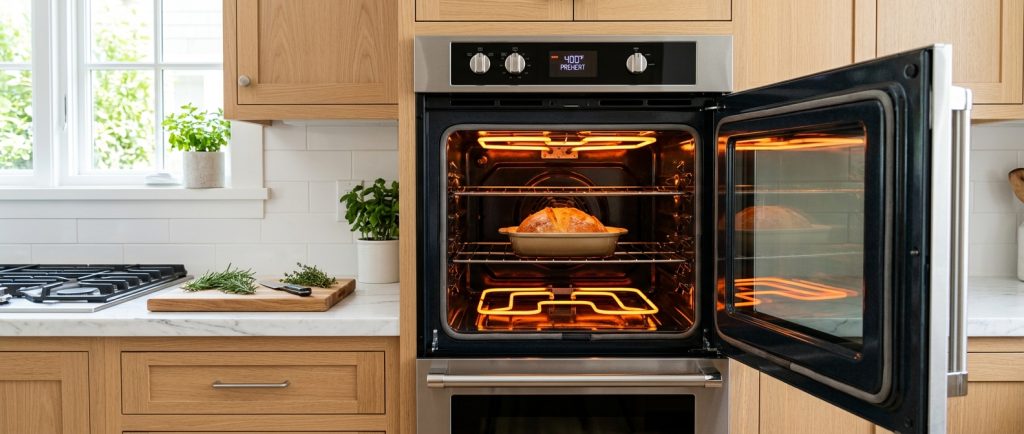
The bake element is the most common failure point in electric ovens. It’s the coiled heating element at the bottom of the oven cavity. When it fails, bake mode stops working entirely while the oven may still appear functional in other ways, the clock works, the broiler might still function, but the oven simply never reaches temperature.
After switching the oven off and letting it cool, look for obvious breaks, cracks, blistering or burnt spots without removing panels. Visible damage is enough reason to stop using the oven. An element can also fail without visible damage, but continuity and voltage testing should be handled with model-specific service information by a qualified person.
A visibly damaged element needs a model-matched replacement. Because element terminals and wiring sit behind the oven liner, replacement involves electrical access and should not be attempted with the appliance energized. A technician can confirm the element, wiring and control circuit before a part is ordered.
Note that on convection ovens, there’s often a separate convection element at the back of the cavity in addition to the bake element at the bottom. If convection heat works but bake doesn’t, the bottom bake element is the problem. If neither works, the issue is further upstream in the control circuit.
Broil Element and Dual-Element Ovens
The broil element sits at the top of the oven cavity. On many modern ranges, it handles both the broil function and contributes to preheat on certain models. If your oven heats partially, takes forever to reach temperature, or only the top of food gets cooked, the broil element may have failed.
Some oven models use a hidden bake element under the oven floor with the visible broil element doing the heavy lifting during preheat. If yours is this type and the broil element fails, preheat will either stop working or take dramatically longer than normal.
Broil element failures are less common than bake element failures because broil mode sees less continuous use in most households. When they do fail, the pattern is usually a visible break in the element coil or a circuit test showing no continuity.
A visibly failed broil element also needs a model-matched replacement. Because its terminals and wiring are behind the oven liner, have the element and supply circuit confirmed before ordering a part. Do not use the oven while an element is cracked, blistered or sparking.
Gas Oven Igniter Problems
Gas oven igniters are the most common failure point in gas ovens. The igniter serves a dual purpose: it glows to ignite the gas, and it draws enough current to open the gas valve. As igniters age, they weaken and no longer draw sufficient current to open the valve reliably, even if they still glow.
This creates a confusing symptom: you can see the igniter glowing orange, but the burner never lights. The igniter appears to be working but the gas valve stays closed. The igniter has weakened below the threshold needed to open the valve, even though it still glows enough to be visible.
Igniter specifications and test procedures vary by model and require live electrical measurement near gas components. Do not loosen gas fittings, remove the burner assembly or attempt live testing. If you smell gas, leave the area and contact the gas utility or emergency services from a safe location. Gas appliance work must be handled by a technician licensed for that work in Nova Scotia.
Temperature Sensor and Thermostat
The temperature sensor is a probe that extends into the oven cavity and reports the internal temperature to the control board. If it fails, the oven either won’t heat at all (board sees an out-of-range reading and shuts down heating), heats inconsistently, or displays an error code.
Common symptoms of a failing sensor: oven runs too hot or not hot enough even when set correctly, food comes out burnt on the outside and raw in the middle, or the oven displays an F-series error code (F2, F3, F5 depending on brand). These error codes often point directly to the temperature sensor.
Sensors test with a multimeter as well. Most oven temperature sensors should read approximately 1,000 to 1,100 ohms at room temperature. Significantly outside that range means the sensor is faulty. Replacement sensors run $15 to $40 and are typically mounted with one or two screws inside the oven cavity.
Older ranges with mechanical thermostats rather than electronic sensors are a different situation. The thermostat is a capillary tube and bulb system that regulates temperature mechanically. These rarely fail completely but can drift over time, causing the oven to run significantly hotter or cooler than indicated. Calibration is sometimes possible through the control panel; full replacement is the other option.
Control Board and Electronic Ignition
The control board is the least likely cause of an oven not heating, but it does happen. When the board fails, it may not send the heating signal at all, making it seem like the element or igniter is the problem when the real issue is upstream.
Before assuming the board is bad, rule out everything else. Control boards are expensive, $100 to $300 depending on the oven brand, and misdiagnosis is costly. A tech with the right diagnostic tools can confirm a board failure with certainty rather than guessing.
On gas ranges with electronic ignition (the type that clicks when you turn a burner on), control board failures can also affect the oven ignition circuit while leaving the surface burners working normally. If your surface burners click and light fine but the oven does nothing, and you’ve ruled out the igniter and sensor, the board is worth investigating.
What Halifax Homes Should Know
Halifax homes have a mix of gas and electric cooking setups. Older homes in the South End, North End, and Dartmouth often have gas ranges. Newer condos and apartments, especially in the downtown core and Bedford, typically have electric. Knowing which type you have matters because the diagnostic path is completely different.
Atlantic humidity and salt air don’t directly affect oven internals the way they affect exterior appliances, but they do contribute to connector corrosion on older ranges. If your oven started having intermittent heating issues that come and go rather than a complete failure, corroded wire terminals at the element or sensor connections are worth checking.
HRM’s electrical grid is stable but the area does see occasional power surges during severe weather. Control board failures sometimes follow a major storm event. If your oven stopped working after a notable weather event, mention that to your technician, it helps focus the diagnosis.
FAQ: Oven Not Heating in Halifax
My oven turns on but won’t heat up. What should I check first?
First confirm the cooking mode, temperature setting, door closure and power supply. With an electric oven off and cool, look for visible element damage without removing panels. If a gas oven has delayed ignition, fails to light or smells of gas, stop using it and arrange licensed service.
My oven preheats but takes forever and doesn’t reach temperature. Why?
Slow preheating with a failure to reach the set temperature usually points to a partially failed element, a weak gas igniter cycling on and off, or a faulty temperature sensor giving inaccurate readings to the control board. These faults can produce similar symptoms, so model-specific electrical or gas diagnosis should be handled by a qualified technician.
How much does oven repair cost in Halifax?
A bake element replacement typically runs $100 to $180 including parts and labour. Gas igniter swaps are similar, $120 to $200 installed. Temperature sensor replacement is usually $80 to $140. Control board replacement is $200 to $400 depending on the brand. Diagnostic call-outs in Halifax are typically $80 to $100, credited toward the repair if you proceed.
Should I repair or replace a 12-year-old oven that stopped heating?
If the repair is a bake element or igniter, even on a 12-year-old range, the cost is usually low enough that repair makes sense. If the control board has failed on a 12-year-old range that’s also showing other wear, replacement becomes more attractive. The break-even point is generally when repair costs exceed 50% of a comparable replacement appliance.
Is it safe to use a gas oven if the igniter is weak?
A weak igniter that can’t reliably open the gas valve may cause the oven to attempt to ignite, fail, then try again with unburned gas in the cavity. This is a safety concern. If your gas oven’s igniter is slow or unreliable, don’t use the oven until it’s repaired. Gas accumulation in an enclosed oven cavity before ignition is genuinely dangerous.
Book Oven Repair in Halifax Today
Max Appliance Repair serves Halifax, Dartmouth, Bedford, Sackville, and the broader HRM area. Same-day times are often available, depending on scheduling, travel and parts availability. Whether it’s a failed bake element, a gas igniter that’s not lighting, or an error code you can’t clear, a diagnosis is the fastest way to get your oven working again. Call or book online now.
Need a hand with this? Max Appliance Repair Halifax offers oven repair appointments in Halifax. Same-day times are often available, depending on scheduling, travel, and parts availability. The service-call fee is waived when the recommended repair is completed. Call (902) 904-5559.