Last updated: August 13, 2026
That said, there is a version of the gurgle that does signal trouble. Below is how to tell the harmless everyday sounds apart from the ones worth a closer look, a quick list you can run through in two minutes, and the red flags that mean it is time to stop guessing and call a technician.
In this article
Why your fridge is making gurgling noise in the first place
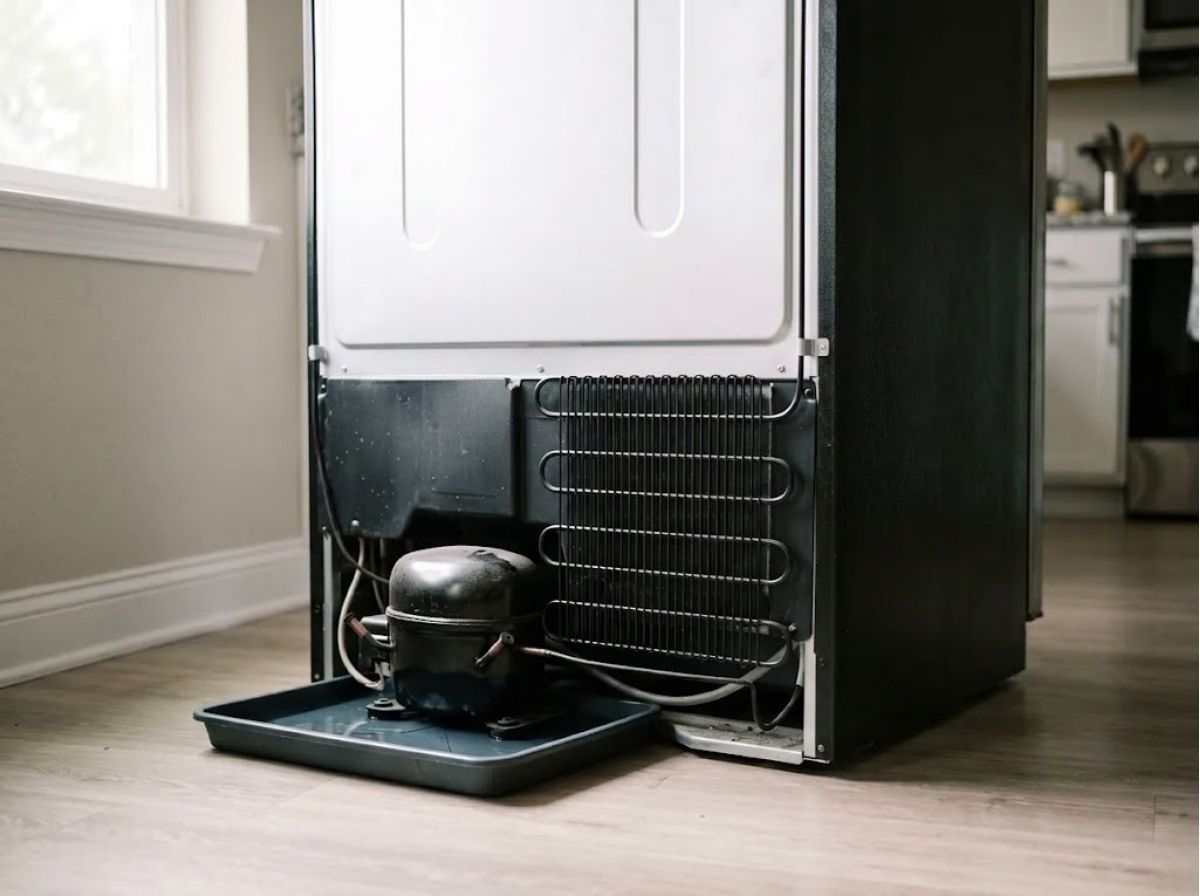
Your refrigerator is a small pump that never really sleeps. To keep the inside cold, it pushes a chemical called refrigerant around a loop of coils, switching it between a liquid and a gas. Every time that liquid flashes into vapour, or vapour condenses back into liquid, it moves. That movement is what you hear as a gurgle, a bubble, or a soft hiss.
There is a second common source too. Modern fridges defrost themselves on a timer. When the cycle finishes, the melted frost runs down a small tube into a shallow pan near the compressor, where it evaporates. That trickle can sound like water running somewhere it should not be. Both of these are the machine doing exactly what it was built to do.
Quick take
Gurgling by itself is commonly part of normal cooling or defrosting. Treat it as a warning when an appliance thermometer shows the fridge is above 4 C, frozen food softens, water pools, or the sound comes with a burning or electrical odour.
When a fridge making gurgling noise is completely normal
Manufacturer guidance treats several short, repeatable gurgling sounds as normal operation. The timing matters: these sounds often line up with one of the following moments.
- Right after the compressor kicks on or shuts off. Refrigerant keeps flowing and settling for a minute or two, so a brief gurgle or bubble at those points is expected.
- A little while after you close the door on a warm load. The fridge works harder to pull the temperature back down, and you hear more refrigerant movement while it does.
- A soft trickle every few hours. That is the defrost cycle sending melt water to the drain pan. Newer fridges run this quietly, older ones less so.
- A gentle hiss or pop from the back or bottom. Coils and plastic parts expand and contract as temperatures shift, and that flexing makes small sounds.
- Louder gurgling in the first day or two after delivery or after you have moved the fridge. The refrigerant needs time to settle back into its normal path
When the gurgle is worth a second look
The sound itself is rarely the problem. What turns a normal gurgle into a warning is the company it keeps. Pay attention when the noise shows up alongside any of these:
- The fridge is not as cold as it used to be. A gurgle plus food that spoils faster or a freezer that will not hold ice can point to a refrigerant or airflow issue.
- The sound is constant and loud rather than a brief cycle. Nonstop, aggressive gurgling or a churning noise that never settles is not the same as an occasional bubble.
- There is water pooling under or inside the fridge. If the trickle you hear ends in a puddle, the defrost drain may be clogged or the drain pan cracked.
- You notice a burning or electrical odour. Unplug the refrigerator if it is safe to do so and arrange service; do not remove panels or test live components.
- The compressor runs almost constantly. If the fridge never seems to rest and gurgles the whole time, it may be struggling to reach temperature
What to check before you worry
Run through this quick list. Most of the time it either settles your nerves or points you straight at a small, fixable cause:
- Check the temperature, not just the sound. Use an appliance thermometer in the centre of the fridge. Health Canada recommends 4 C (40 F) or below; warmer readings combined with gurgling deserve attention.
- Look for water. Pull the fridge out a little and check the floor and the bottom of the interior. A dry floor and a slightly damp drain pan are both fine. A puddle is not.
- Time the sound. Does it come and go with the compressor cycling, or does it never stop? Intermittent is normal. Constant and loud is worth attention.
- Check that the fridge is stable and level. Follow the levelling instructions in the model manual because the required front-to-back position varies by appliance.
- Check ventilation and accessible coils. Use the clearances and cleaning method in the model manual; restricted airflow can increase run time and make normal operating sounds more noticeable.
- Note any odour. A burning or electrical smell is not a normal cooling sound. Unplug the appliance if it is safe and arrange service.
Pro tip
Follow the model manual for accessible-coil cleaning, door-seal care and ventilation clearances. Restricted airflow can increase run time and make normal sounds more noticeable. Do not remove a sealed rear cover solely to reach coils.
Normal versus worry: a quick comparison
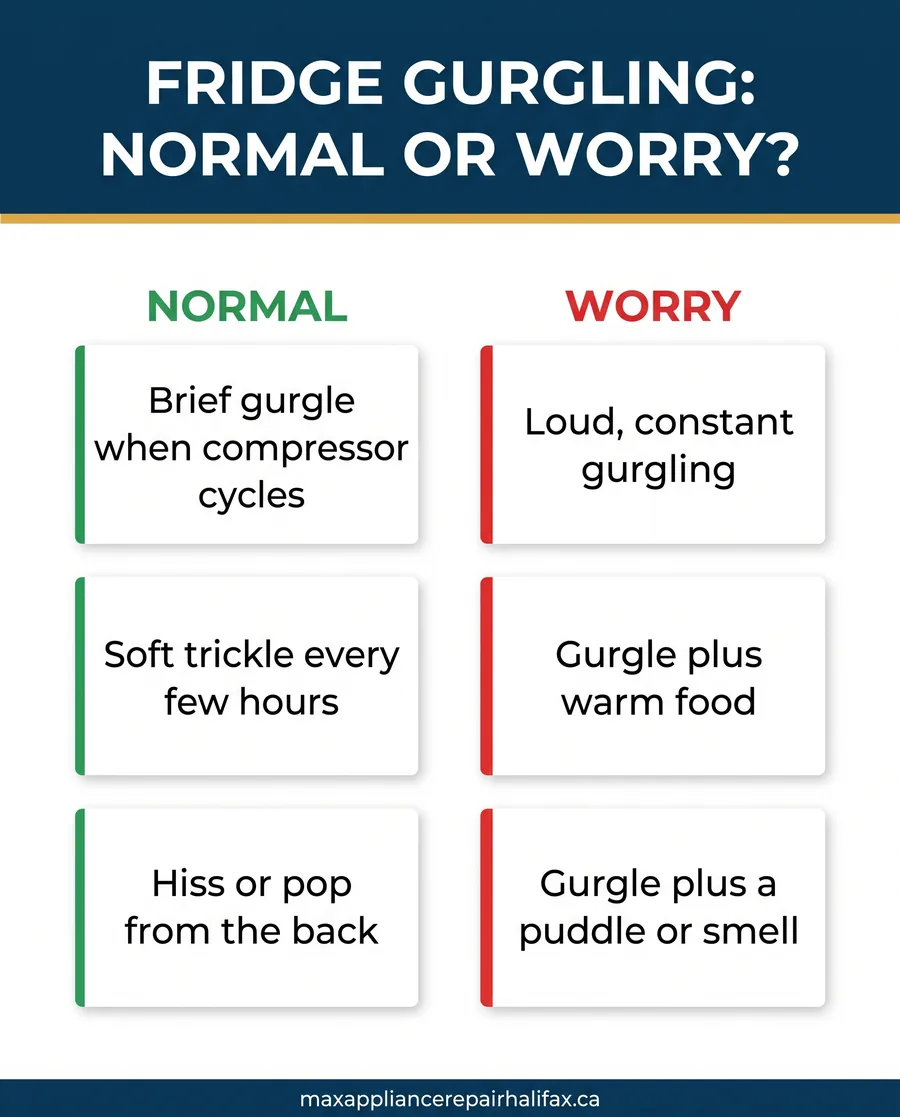
Here is the same idea in one glance. Match what you are hearing and seeing to the row that fits, then decide whether to relax or make a call.
| What you notice | Likely cause | Normal or worry? | What to do |
|---|---|---|---|
| Brief gurgle when the compressor cycles | Refrigerant settling in the coils | Normal | Nothing, this is expected |
| Soft trickle every few hours | Defrost water draining to the pan | Normal | Nothing, unless it ends in a puddle |
| Hiss or pop from the back | Parts expanding and contracting | Normal | Nothing, this is thermal movement |
| Loud, constant gurgling that never stops | Possible refrigerant or airflow issue | Worry | Check cooling, then book a diagnostic |
| Gurgle plus warm food or lost ice | Cooling, airflow, defrost or sealed-system fault | Worry | Call a technician, protect your food |
| Gurgle plus a puddle inside or under | Clogged or cracked defrost drain | Worry | Stop, check the drain, call if unclear |
| Gurgle plus a burning or electrical smell | Possible electrical or overheating fault | Worry | Do not keep running it, call right away |
Download the free quick guide
A one-page checklist to tell a harmless fridge gurgle from a real problem, and what to do about each.
When to call a Halifax appliance pro
If the refrigerator stays at 4 C or below, the freezer holds its normal temperature and there is no leak, a brief gurgle is usually normal. Book diagnosis when the sound comes with rising temperatures, an unexplained puddle, repeated breaker trips, a burning odour or continuous running. Cooling faults can have several causes, and sealed-system or electrical work is not a safe DIY diagnosis.
Max Appliance Repair Halifax diagnoses refrigerator cooling, drainage and noise complaints across Halifax, Bedford, Dartmouth and Sackville. If the fridge is not cold, note the measured temperature, model number, when the sound occurs and whether water is present before you book a diagnostic. That information helps separate a normal cycle from a repair symptom.
Frequently Asked Questions
Still not sure whether the gurgle is normal? Note the measured temperature, model number, timing of the sound and whether water is present. Max Appliance Repair Halifax services refrigerators across Tantallon and Timberlea, Halifax and the wider HRM. Book a diagnostic when the sound comes with a cooling or leak symptom.